

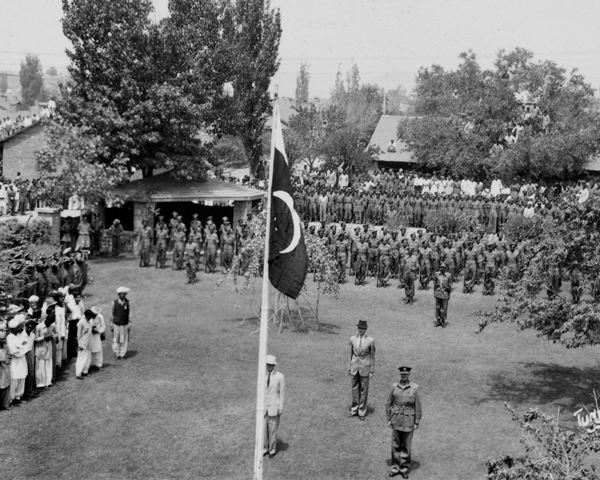
The Partition of British India in August 1947 remains one of the most transformative and agonizing chapters of the 20th century. It was not merely a political relocation of borders; it was a seismic shift that dismantled a centuries-old social fabric, resulting in the creation of two sovereign states—India and Pakistan—and the largest mass migration in recorded human history.
I. The Ideological Schism: Why Partition Happened
The road to 1947 was paved with a gradual breakdown of trust between the Indian National Congress and the All-India Muslim League. By the mid-1940s, three primary forces made the division of the subcontinent seem inevitable to the British and Indian leadership.
1. The Two-Nation Theory
Muhammad Ali Jinnah, once a proponent of Hindu-Muslim unity, became the face of the “Two-Nation Theory.” This ideology posited that Hindus and Muslims were not merely two religious communities but two distinct nations with incompatible cultures, laws, and social structures. The Muslim League feared that in a post-British democratic India, Muslims would face “majoritarian tyranny” under a Hindu-dominated Congress.+1
2. The Failure of Power-Sharing
The 1946 Cabinet Mission Plan was the final attempt to keep India united. It proposed a three-tier federation with a weak center and strong autonomous provinces. When the Congress (led by Jawaharlal Nehru) and the Muslim League failed to agree on the interpretation of “grouping” provinces, the plan collapsed.+2
3. The Descent into Violence
The “Direct Action Day” called by Jinnah in August 1946 triggered the “Great Calcutta Killings.” This communal bloodbath spread like wildfire to Bihar and the Punjab, convincing British Viceroy Lord Louis Mountbatten that a unified India would descend into a full-scale civil war if independence were not granted immediately.
II. The Radcliffe Line: Drawing Borders in the Dark
In June 1947, the British government announced the 3rd June Plan, accelerating the departure of the British from 1948 to August 1947. To handle the logistics of the split, a British lawyer named Sir Cyril Radcliffe was appointed to head the Boundary Commission.+1
Radcliffe was given just five weeks to divide 175,000 square miles of territory. He had never visited India before and possessed no local knowledge. Using outdated census maps, he drew a line that sliced through homes, villages, and vital water systems.
- The Punjab: Divided into West Punjab (Pakistan) and East Punjab (India).
- Bengal: Divided into East Bengal (Pakistan) and West Bengal (India).
Crucially, the exact location of the borders was kept secret until August 17, 1947—two days after independence—leaving millions of people in a state of terrifying uncertainty about which country they were actually in.
III. The Great Migration and the Human Toll
The announcement of the borders triggered a panic of biblical proportions. Families who had lived together for generations suddenly found themselves on the “wrong” side of a religious line.
1. The Migration of 15 Million
Approximately 14 to 15 million people took to the roads. Hindus and Sikhs moved East; Muslims moved West. They traveled in “foot columns” (kafilas) that stretched for miles or crammed onto the roofs of trains.
2. The Communal Holocaust
The migration was characterized by extreme brutality. Mobs from all communities engaged in ethnic cleansing. Trains arrived at stations in Lahore and Amritsar filled with corpses—”death trains” that became the haunting symbols of the era.
- Casualties: While official records are imprecise, historians estimate that between 500,000 and 2 million people were murdered.
- The Plight of Women: An estimated 75,000 to 100,000 women were abducted, raped, or forcibly converted, often by members of their own communities to prevent them from falling into “enemy” hands—a concept known as “protecting family honor.”
IV. The Geopolitical Legacy: A Century of Rivalry
Partition did not bring the peace the British had hoped for. Instead, it institutionalized a rivalry that continues to shape South Asia in 2026.
1. The Princely State Dilemma
While British India was divided, 565 Princely States were given the choice to join either nation. Most chose based on geography, but Jammu & Kashmir became a flashpoint. The Hindu Maharaja of a Muslim-majority state hesitated, leading to the first Indo-Pakistani War in October 1947. The region remains a disputed territory and a nuclear trigger point today.
2. The Birth of Bangladesh (1971)
The original Pakistan was geographically bifurcated into West and East Pakistan, separated by 1,000 miles of Indian territory. Cultural, linguistic, and economic disparities between the two wings eventually led to the 1971 Liberation War, resulting in East Pakistan becoming the independent nation of Bangladesh.
| Key Impact | Long-Term Consequence |
| Refugee Integration | Transformed cities like Delhi and Karachi into massive urban hubs. |
| Nuclear Proliferation | The ongoing rivalry led both nations to become nuclear-armed states. |
| Cultural Trauma | A shared history of literature, music, and food remains deeply scarred by the memory of the “Partition riots.” |
V. Conclusion: A Lesson in History
The Partition of 1947 was a “surgical operation” performed with a blunt instrument. While it birthed two nations that have gone on to achieve significant global status, the foundation of that sovereignty was laid in blood and displacement. Understanding Partition is essential to understanding the modern identity of every person in the subcontinent; it is a reminder of how quickly political rhetoric can transform into humanitarian catastrophe
